
Cloudy Days Make Osaka's Minami Easier to Photograph: A Walk from Minami-Horie to Dotonbori, Following the Scenery as It Changes
Cloudy Days Make Osaka's Minami Easier to Photograph: A Walk from Minami-Horie to Dotonbori, Following the Scenery as It Changes
You open the weather app in the morning and see cloud icons lined up for the whole day. On a trip, that usually gets a groan. But hold on a second. If you're taking photos in Osaka's Minami district, a white sky is actually on your side.
From the calm streets of Minami-Horie to the lively riverside of Dotonbori, the character of this area changes every few blocks. One minute it's quiet, then you turn a corner and suddenly it's loud. Cloudy light captures those shifts surprisingly well.
This article is for two people traveling to Osaka together. It follows Minami on a cloudy day in the order the scenery changes. It covers what's easy to photograph and where, where a street kart tour fits into the route, and how to split up limited time. I'll describe what you'll actually see, as it really looks.
A White Sky Isn't the Enemy of Photography
What do you think is the biggest problem with street photos on a sunny day? It's actually shadows. The gap between building shadows and sunlit areas is so big that half the street comes out pitch black and the other half is blown out white. Take a photo of two people side by side, and one of them gets a hard shadow across their face. "Why do I look like the suspect in a crime drama?" You know the kind of photo.
On a cloudy day, the whole sky works like a giant lighting umbrella. In photography there's a tool called a "diffuser" that softens and spreads light. It's the white cloth or translucent panel held in front of studio lights. An overcast sky is like draping one of those over the entire city. Light doesn't come from just one direction. It wraps around from all sides. That softens the edges of shadows, so faces, signs, and storefronts are more evenly lit.
There is one weakness, though: the sky itself tends to come out pure white. Smartphone cameras try to set exposure for the bright sky, so if you include a lot of it, the street in front of you turns dark. On cloudy days, the trick is to keep the sky to a thin strip at the top of the frame, or leave it out completely. You can also use the white sky as a plain backdrop. Think of it as placing the city on a blank sheet of white paper.
One more thing I should be honest about. "Cloudy" can mean very different light depending on how thick the clouds are and the season. With thin clouds, it's barely different from a sunny day. With thick clouds, the city starts to feel dark early. So this article won't tell you the best time of day to shoot. Instead, it looks at which scenes to photograph first and which to save for later as the sky gets dimmer.
Minami-Horie: Where Glass Storefronts Photograph Most Naturally
The first scene is Minami-Horie, home to Street Kart's Osaka shop. It's a street full of shops and cafés, and the atmosphere is relatively calm for Minami. Minami has a reputation for being flashy, but this area speaks a notch quieter. The shop is a 3-minute walk from Nishi-Ohashi Station on the Osaka Metro Nagahori Tsurumi-ryokuchi Line, and a 5-minute walk from Yotsubashi Station on the Yotsubashi Line. Once you're through the ticket gate, it's not far enough to get lost.
A side note: the line is written "四つ橋線" and the station "四ツ橋." One uses the katakana "ツ" and the other the hiragana "つ," and even locals pause for a second when writing it. It doesn't really matter, but comparing the two on the signs while you take photos is kind of fun.
Back to the main point. What makes a cloudy day great on this street is how glass behaves. On a sunny day, shop windows clearly reflect the buildings across the street and the blue sky, so you can barely see inside. On a cloudy day the reflections are weaker, so the lights and displays behind the glass come through clearly. The street outside and the shop interior overlap in a single frame, which gives the photo depth.
If there are two of you, one person can stand slightly to the side of a storefront while the other shoots from across the street. Put the person near the edge of the frame and fill the rest with the depth of the street. Since the shadows aren't harsh, you don't have to worry much about which way someone is facing for their expression to come through.
One note on photo etiquette. In some countries nobody minds if you photograph a shopfront, but in Japan some shop staff do. If you want to photograph the inside of a shop or its products, ask first. In Japanese, "May I take a photo?" is "Shashin o totte mo ii desu ka?" Point at your camera while you say it and you'll usually get the message across. Osaka shop staff might even throw in a comment or two of their own.
Amerikamura: The More Colorful the Area, the More a Cloudy Day Helps
Walk east from Minami-Horie and the atmosphere changes completely. Amerikamura, about a 5-minute walk from the shop, is an area packed with vintage clothing stores and streetwear shops. In the middle is a small plaza called Sankaku Koen, or "Triangle Park." True to its name, it really is a triangle. Lots of Osaka place names are like that, describing exactly what you see, and their selling point is that they're easy to understand.
Here, what "switches" is the amount of color. You go from Minami-Horie's muted tones to a sudden flood of color: signs, clothes hanging outside shops, painted walls. Photograph a place like this on a sunny day and the colors in the sun wash out while the colors in the shade sink, so they never quite come together.
On a cloudy day, colors stay steady. Red stays red, yellow stays yellow. A white sky in the background can even make the colors on the ground stand out more. Patterns on clothes hanging in front of vintage shops, for example, come out in finer detail on a cloudy day. When you can make out every square of a plaid shirt, it feels like you got a little bonus.
In places where people gather, like Triangle Park, strangers tend to end up in your shots. Some people in Japan are sensitive about photos where their face is clearly visible being posted on social media, so check your photos before you post. When it's crowded, try shooting from a slightly lower angle, looking up at the signs and buildings. That keeps faces out of the frame more easily. If you crouch down to shoot, a local might peek over and ask, "What're you taking pictures of?" That's part of Minami's charm too.
Street Kart Time Is for Taking In the Scenery with Your Eyes
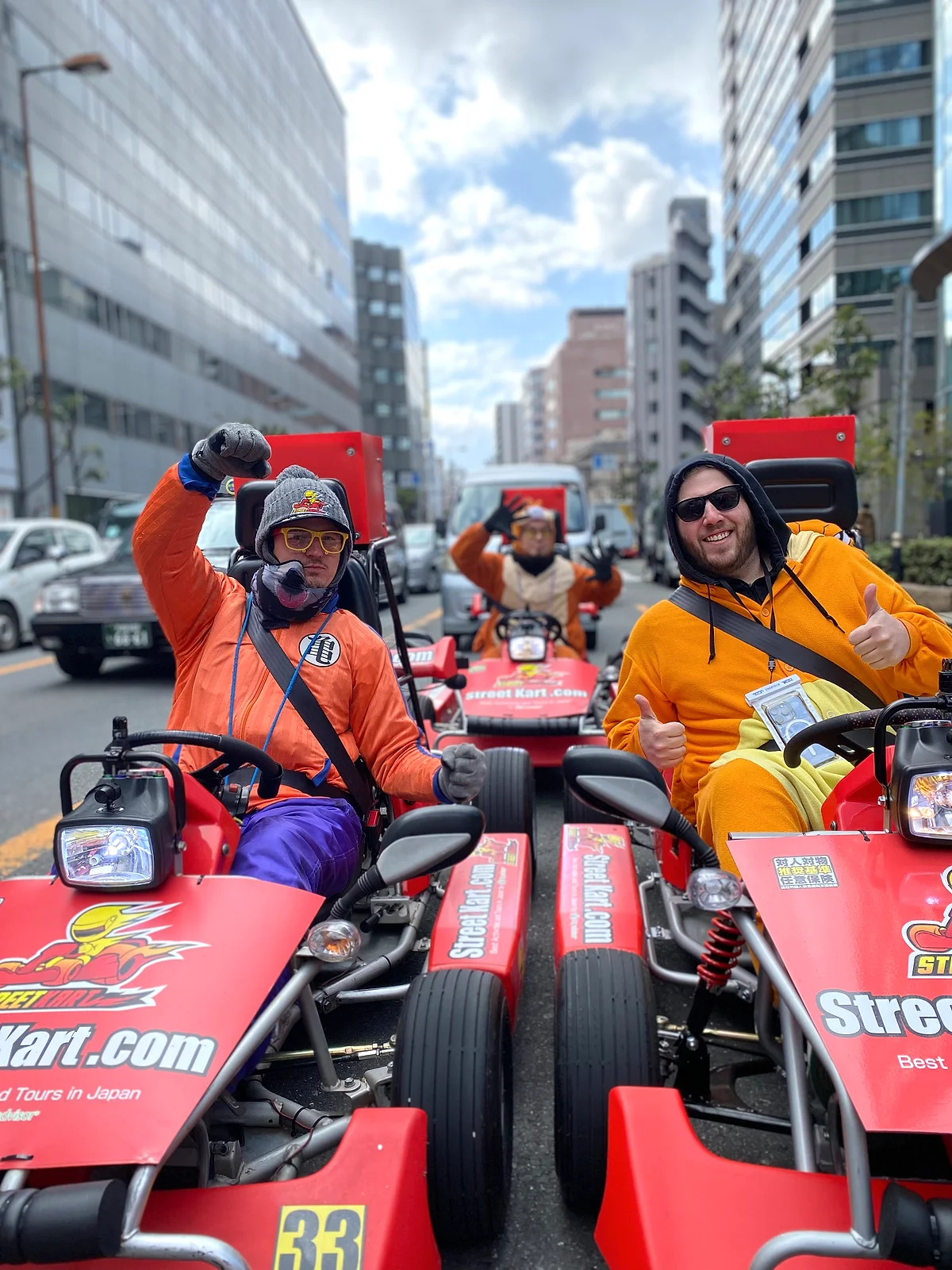
After walking and photographing Minami-Horie and Amerikamura, put the camera away for a while and head to the street kart tour. Street Kart's Osaka tours follow a set route led by a guide. You don't drive wherever you like. The route runs from Amerikamura through Shinsaibashi, Dotonbori, and Namba, so this time you'll be heading into the Minami streets you just walked, but by kart.
Let me be clear about this: don't hold your smartphone and take photos while driving. While your hands are on the wheel, your focus belongs on the kart ahead, the guide's signals, and the traffic around you. For rules on mounting cameras or filming, check the official website before booking, or ask the staff on the day.
This "no-photo time" may actually be the most memorable part of cloudy-day Minami. Your eye level is different from when you walk, and signs you didn't even look up at earlier flow by overhead. Sounds from storefronts and people's voices reach your ears directly. On a cloudy day you're rarely squinting against the sun, so you can calmly watch how the streets you just walked and photographed change before your eyes.
The quiet of Minami-Horie and the colors of Amerikamura that you photographed on foot. On the tour, you take in the flow of the city that connects them with your whole body, without stopping. It won't be in your photos, but when you look back at them later, the scenery in between should come back to you naturally. Photos are funny that way. They can also work as a switch that pulls up memories of what isn't in the frame.
I can't say for sure whether tours will run on days when clouds might turn to rain. It's best to check the official website for how weather-related decisions are made.
Why Street Kart: What to Know Before Choosing the Osaka Shop as a Pair
First, tours are led by trained guides. You follow the guide for every turn and every stop, so both of you just need to look ahead and drive in time with the signals. Personally, I'm not great at walking around an unfamiliar city while staring at a map app, so this kind of setup feels easy and relaxed to me.
Next, language. Guidance on the day of the tour is basically in English. Guidance in Japanese or other languages depends on the staff that day and isn't guaranteed. If you have concerns, reach out through the official website in advance.
The official website you'll use for research before booking is available in 22 languages. That applies only to the website, which is separate from the guidance on tour day, so keep the two apart in your mind.
Here are some numbers too. As of November 2023, across all shops combined, there had been more than 150,000 tours, more than 1.34 million total customers, and more than 20,000 reviews, with an average rating of 4.9 out of 5. These figures are from a while ago, so note that they aren't current.
There are 9 shops nationwide: 7 in Tokyo, 1 in Osaka, and 1 in Okinawa. The Minami-Horie shop is the only place to ride in Osaka, so if you're adding it to your Osaka itinerary, it makes sense to pair it with a walk around Minami.
The shop has a restroom and Wi-Fi. If it were me, I'd show each other the photos we took on foot before heading out: "This one's great." "Nah, this one's better."
One last thing. Since the route is fixed, there's no need to worry about where to drive. That frees up your time as a pair to decide where to walk and photograph before and after the ride. This article is built around exactly that idea.
Shinsaibashi's Arcade and Dotonbori: The Darker the Sky, the More the Signs Take Center Stage
After the tour, take the camera back out and head east. Shinsaibashi, about a 15-minute walk from the shop, is home to Shinsaibashi-suji Shopping Street, a long covered shopping arcade. In Japanese this kind of street is called a "shotengai," a shopping street mixing local shops and large stores. For Osaka locals, a shotengai is less a place to shop and more a way to get around. Walking to the station by linking up arcades on a rainy day is a bit of local know-how.
That's exactly what makes this arcade so reliable on a cloudy day. Even if the weather turns, you can keep walking. If the clouds thicken and it starts to drizzle, you can keep your umbrella closed under the roof. Inside, light filtering through the roof mixes with the shop lights, so the brightness doesn't depend much on the weather outside. Daimaru Shinsaibashi is also about a 15-minute walk from the shop.
From there, go further south. About a 20-minute walk from the shop brings you to Dotonbori. Here the scenery switches dramatically once again. The Glico sign, the Kani Doraku sign, Kuidaore Taro. The Dotonbori River Walk runs along the water, letting you view the sign-lined street from across the river. Calling it a city where the signs are the stars might sound like an exaggeration, but I think you'll agree once you're standing there.
This is the most interesting part of a cloudy day. While the sky is still bright, the signs are just part of the streetscape. But as the light under the clouds gradually fades, the signs start to stand out more by comparison, and their colors reflect on the river. As the white sky sinks into gray, the starring role passes from the sky to the signs. In my experience, you can feel this transition more clearly on a cloudy day than on a sunny one.
For composition, an easy option is to shoot from the River Walk with both the river and the signs in the frame. As a pair, one person stands near the railing while the other steps back a bit to fit the signs into the background. When it's crowded, don't hog the spot. Take a few shots and then let the next people have a turn. That's the etiquette here. Once you can do that, you're already halfway to being a Minami local.
Eat, Walk, and Finish in Namba
Once you reach Dotonbori, food becomes part of the scenery. Kukuru for takoyaki and Kinryu Ramen are in Dotonbori. For okonomiyaki, there's Mizuno in Shinsaibashi and Chibo, about a 10-minute walk from the shop. The smell of sauce caramelizing on the griddle drifts out just as you walk down the street. I've yet to meet anyone who can smell that and walk right past. For food photos, a window seat lets you use the soft light of the overcast sky.
As for payment, even if you're used to paying by card, it's reassuring to carry a little cash. There are convenience store ATMs near the shop.
After eating, head to Namba. It's about a 20-minute walk from the shop, an area with Namba Grand Kagetsu and Namba Parks. Namba Station is served by Osaka Metro, Nankai, and Kintetsu, so ending your day here makes getting back to your hotel simple.
Starting at the quiet storefronts of Minami-Horie, then the colors of Amerikamura, the Shinsaibashi arcade, the signs and river of Dotonbori, and finally the area around Namba Station. Line up your photos in the order you walked, and the gradual shift in Minami's scenery becomes one continuous story.
How to Split Limited Time as a Pair on a Cloudy Day
There's only one thing that really matters in how you use your time: photograph the fine details while the sky is still bright, and photograph things that glow once it starts getting dark. Minami-Horie's storefronts and Amerikamura's colors show more detail while there's still light. The signs of Dotonbori gain presence in your photos the more the sky darkens.
If your tour is booked early in the day, walk a bit of Minami-Horie beforehand, then after the tour flow from Amerikamura to Dotonbori and Namba. That way the changing light lines up with your walking order. If your tour is later, you could visit Amerikamura and the Shinsaibashi arcade first, return to the shop, and head to Dotonbori after the tour. Either way, I'd recommend not locking in exactly what to do at what time, and leaving room to swap the order based on that day's sky. Pack your schedule too tight and you won't even have time to look up at that lovely overcast sky.
The shop has no parking. Please use Osaka Metro or other public transportation. From Nishi-Ohashi or Yotsubashi Station, it's only a few minutes' walk to the shop.
There are also tricks that work especially well for two travelers. Take turns being the photographer and the one watching the bags, and you won't get flustered in crowded spots. Share your photos between both smartphones the same day, so you're covered if one battery dies. There are convenience stores within a 5-minute walk of the shop, so if you're worried about your power bank running low, stop by early.
What to Check Together Before Booking
Karts are single-seaters, so if you're traveling as a pair, you'll both be drivers. Driver's license requirements vary from person to person, so each of you should read the official page on driver's licenses and confirm you can join with your license.
Weekends tend to fill up, so once your itinerary is set, it's best to book early. Reservations are accepted via Facebook, LINE, and email. Contact details and the latest information are on the Street Kart official website, so look through it together to keep things smooth. For weather-related decisions about whether tours run and rules about photography, check the official website or get in touch.
If the forecast shows a row of cloud icons, it might be a day when the shop interiors behind Minami-Horie's glass, the clothing patterns of Amerikamura, and the signs reflected in Dotonbori's river all come out more naturally than usual. Instead of looking up at the sky, try looking at the city. Under that white sky, watch how Minami's scenery shifts. By the time you're flipping through your album on the train home, the scenes you photographed on foot and the ones you took in from the kart should connect into one continuous flow.
A cloudy day isn't a bad-luck day. In Minami, it's the day the city gets to be the star.
This article was originally written in Japanese and translated using AI. Some expressions may read unnaturally, and we appreciate your understanding. For the most accurate and up-to-date information, please refer to the official site at kart.st.
Street Kart is not affiliated with Nintendo or the Mario Kart series in any way. We do not provide costumes of Nintendo characters, and such costumes may not be worn during tours even if brought by participants.