
Osaka's Minami Shows a Different Face Morning and Evening: Comparing Minami-Horie, Amerikamura, and Dotonbori as a Pair
Osaka's Minami Shows a Different Face Morning and Evening: Comparing Minami-Horie, Amerikamura, and Dotonbori as a Pair
The riverside street in Dotonbori, lined with giant signs, feels like a completely different place in the morning than in the evening. In the morning, commuters hurry along beneath signs that aren't lit yet. Everyone walks like they're thinking, "Gotta get going." By evening, people start gathering in the same spot, and colors spread across the surface of the river. Even the people who were rushing past earlier end up stopping on the bridges.
If you're traveling around Osaka as a pair and have limited time, this difference is worth knowing about. Walking the same street twice gives you a lot more scenes worth photographing. This article covers Minami, Osaka's southern downtown district, from Minami-Horie, where Street Kart's Osaka shop is, through Amerikamura and Shinsaibashi to Dotonbori. It focuses on one thing: how these places change between morning and evening.
Morning in Minami-Horie Feels Closer to a Quiet Residential Neighborhood
Minami-Horie is an area full of shops and cafés. If you know Tokyo, it may help to picture something close to Daikanyama or Ura-Harajuku. Osaka locals might grumble, "Being compared to some place in Tokyo? Come on." Still, the comparison works well enough to give you a sense of the vibe.
Walk through in the morning, though, and that impression shifts a little.
Bicycles glide past storefronts with their shutters still down. Osaka cyclists are fast, even first thing in the morning. Sometimes you can see staff through the glass, getting ready to open. There are few people for how wide the streets are, so you get a good look at the buildings and the sign designs. Your eye goes naturally to the details of each façade (the front of a building), which get hidden behind the crowds from midday on.
By the way, "façade" is a word architects use a lot, so it can sound a bit fancy. All it really means is the building's "face." I think getting a good look at each shop's face is a pleasure you can only really have in Minami-Horie in the morning.
There's one more reason to walk here in the morning. On a quiet street, photos of the two of you side by side come out with clean backgrounds. You also spend less time waiting for strangers to walk out of the frame.
Here's how to get there. The closest station to the Osaka shop is Nishi-Ohashi Station, a 3-minute walk away, and Yotsubashi Station is a 5-minute walk. Both are Osaka Metro stations, so typing "Nishi-Ohashi Station" or "Yotsubashi Station" into Google Maps should keep you from getting lost.
Here's a bit of local trivia. The station name is written 四ツ橋, with a katakana "tsu," but the line is the 四つ橋線, with a hiragana "tsu." Both are read "Yotsubashi," but the spelling doesn't match. If you compare the signs and think "Huh?", don't worry. Neither one is a mistake.
Japanese subway stations tend to have a lot of numbered exits, so checking which exit number you need before you head out of the station makes things easier.
Amerikamura's Triangle Park: An Empty Plaza in the Morning
About a 5-minute walk from Minami-Horie brings you into Amerikamura. Packed with vintage clothing stores and streetwear shops, it's something like the center of Osaka's street culture. Locals almost always shorten it to "Ame-mura," and you rarely hear anyone use the full name.
In the middle of it all is Sankaku Koen, or Triangle Park. As the name says, it's a small triangular plaza.
From evening on, young people sit around here chatting and others stand waiting to meet friends. It's lively, and that scene is classic Ame-mura in itself. In the morning, though, there's hardly anyone. All that's left are the benches, the pavement, and the art painted on the walls of the surrounding buildings.
To be honest, you might wonder, "Is there anything to see in Ame-mura in the morning?" Once you actually walk through, though, the murals and signs register as proper "works." With nobody around, it becomes time to look at the design of the neighborhood itself.
For an American comparison, it might be a bit like walking down a Brooklyn street on a weekday morning when it's usually packed on weekend afternoons. It's a little funny to reach for an American comparison in a place called "America Village," but the soundscape really is completely different in the same spot. In the morning, it's mostly birdsong and distant traffic. By evening, music from shop speakers mixes with the sound of people talking.
If you two want to browse vintage shops, I'd suggest treating the morning as a "scouting run." Opening hours vary from shop to shop, so just note the names of any that catch your eye and come back later. One of the nice things about pairing Minami-Horie with Ame-mura is that they're close enough to make that round trip easily.
Evening in Dotonbori, When the Sign Lights Start Reflecting on the River
Dotonbori is about a 20-minute walk from Minami-Horie. You reach it by passing through Shinsaibashi, a 15-minute walk from Minami-Horie.
Shinsaibashi is a shopping district known for the Shinsaibashi-suji Shopping Street and its long covered arcade. Pass through in the morning and you'll see closed shutters lined up under the roof, with a clear view all the way down the street. It's quiet enough that your footsteps echo off the arcade ceiling. Walk the same arcade in the evening and you'll be moving along with the flow of shoppers carrying bags. A street where you could walk side by side in the morning may have you walking single file by evening. In case you get separated, it's a good idea to agree on something like, "Let's meet at the exit on the Dotonbori side."
Dotonbori in the morning is, honestly, pretty plain. The signs aren't lit, and there's no crowd in front of Kuidaore Taro. Even the Glico sign looks like nothing more than a big board in daylight. Anyone who only knows its nighttime face might be a little let down. That's exactly why morning photos are worth taking, though. The lettering and shapes of the signs and the stone paving of the riverside promenade (the Dotonbori River Walk) all come out clearly.
Another nice thing about the morning is that you can stroll slowly along the river walk. Look up at the signs and you might spot the framework that the lights hide at night. Realizing, "Ah, so this is what holds up all the stuff that glows at night," is a small discovery reserved for people who come in the morning.
Come evening, the whole place changes at once.
While the sky is still a little bright, the sign lights start to stand out, and as it gets darker, the colors on the water deepen. The bridges fill with people, and the smell of takoyaki sauce drifts in from all directions. People stop in front of the Kani Doraku sign with their phones held up. Everyone walks so slowly that it feels like a different city from the morning. Osaka is called the city of "kuidaore," eating until you drop, and it earns the name: walking through Dotonbori in the evening, your nose gives in before your stomach does.
The time it gets dark varies a lot by season. The same "evening" looks completely different in summer and winter, so I recommend checking the sunset time for your travel day in a weather app.
If you want to eat in Dotonbori in the evening, it helps to remember a few names, like Kukuru for takoyaki and Kinryu Ramen for ramen. For okonomiyaki, there's also Chibo. How crowded each place is depends on the day, so if you two don't like waiting in line, shifting your timing a little may make things easier.
If You're Riding a Kart, Which Minami Do You Want to See: Morning or Evening?
So far, this has all been about seeing Minami on foot. Now let's talk about Street Kart.
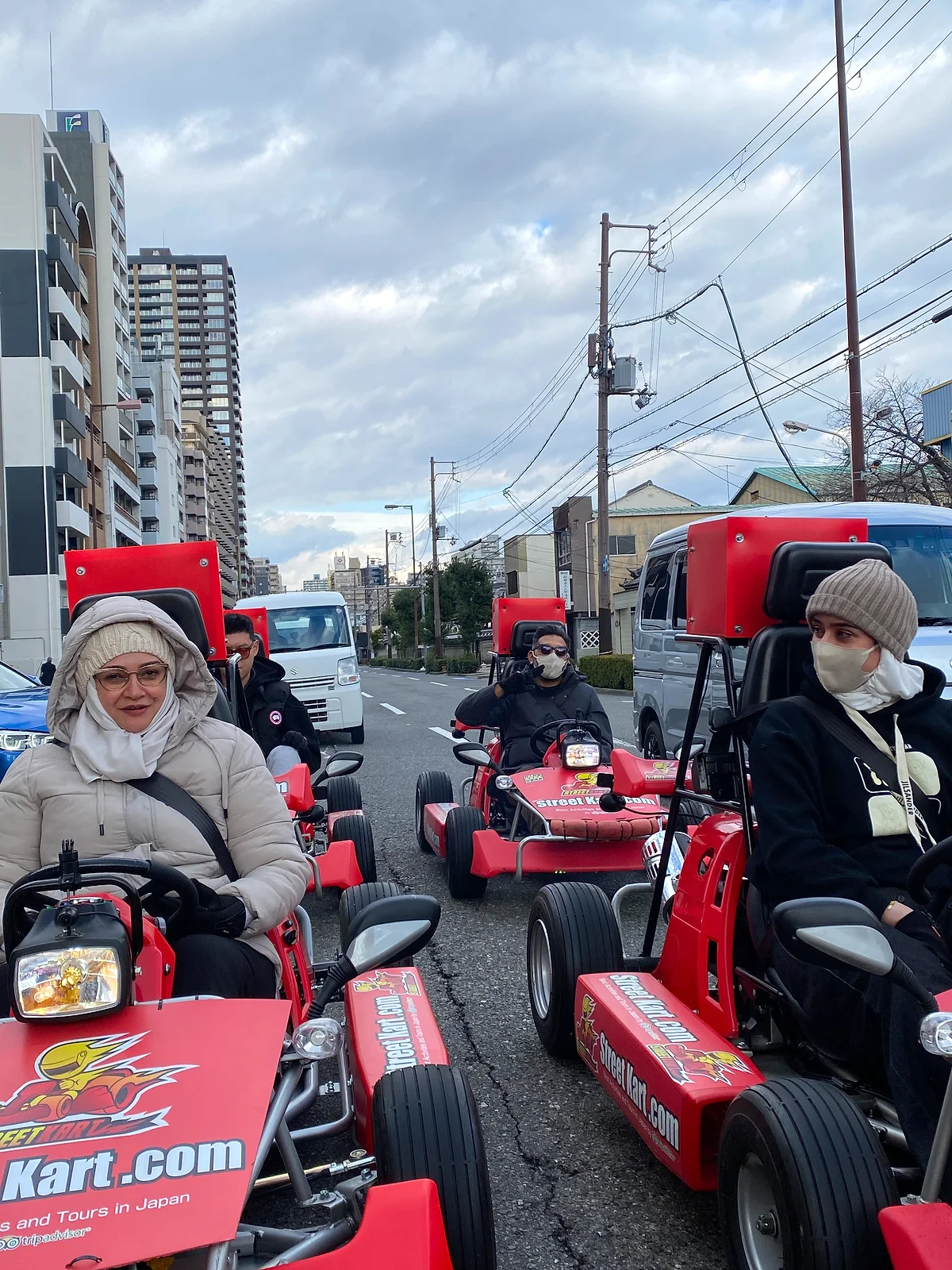
At the Osaka shop, tours follow a set route led by a trained guide. The tours run on public roads under Japanese traffic rules, so you follow the guide's instructions as you go. The route runs from Amerikamura through Shinsaibashi and Dotonbori to Namba, all places covered on foot above. You don't need to memorize the route or watch a navigation app. Just follow the guide in front of you and you'll make your way through the streets of Minami. Minami-Horie, Ame-mura, Shinsaibashi, Namba, Dotonbori: it's a chance to see the heart of Minami from a different height than when you're walking.
The streets you just covered on two feet, you now drive with your hands on the wheel. Even in the same Dotonbori, the way you look up at the signs changes a bit.
This article can't tell you which time slots you'll be able to book. Once your travel dates are set, check the official website or get in touch with them.
With that in mind, here's one idea for how to plan.
If you can ride early, use the tour to get a feel for the city, then walk back to Dotonbori in the evening to see it all lit up. If you ride later, walk Minami-Horie and Ame-mura that morning to see the quiet side of the city first. Either way, if you combine the tour with walking so you "see the same city twice, at different times," I think your impression of Minami will feel much more three-dimensional, even on a tight schedule.
A word about the weather too. In light to moderate rain, tours run as scheduled, and raincoats are provided free of charge. Tours are canceled in heavy rain or typhoons. On a rainy evening, the sign colors blur across the wet pavement, giving you a Minami different from a clear day. For details, including what happens when a tour is canceled, check the official website.
Personally, I think this is where traveling as a pair really pays off. Alone, you might brush off a street with "Eh, I already saw this place." With two of you, it turns into a conversation: "It's totally different from this morning, isn't it?"
What Makes Street Kart Appealing: Things to Know Before You Two Drive Through Minami
First, there's how the kart itself feels. When you actually ride, the sounds and wind of the city reach you directly. Unlike looking through the window of a car or bus, you feel the height of the buildings and the size of the signs with your whole body. In a city like Minami, where buildings and signs are packed tightly together, I find that sensation comes through especially clearly.
Next, there's the shop's location. The Osaka shop is in Minami-Horie, a 5-minute walk from Ame-mura. Everything in this article is within walking distance for before or after your tour. It should be easy to plan something like hopping out of the kart and heading straight to Dotonbori for the evening.
Third, guidance on the day is basically in English. Whether guidance is available in Japanese or other languages depends on the staff that day, so if you'd like a language other than English, ask in advance through the official website.
Fourth, there are the track-record numbers. As of November 2023, across all locations, the company reports more than 150,000 tours run, more than 1.34 million customers, an average rating of 4.9 out of 5, and more than 20,000 reviews. The figures are a little dated, but they give you a sense of how many people have done this tour.
Finally, the website is available in 22 languages. When you want to read the conditions and important notes before booking, start by taking a look at the site.
Take Your Photos While You're Walking
A few words about photos too.
Don't use your phone while driving during the tour. While you're behind the wheel, the basic rule is to focus on driving and on the guide's signals. You'll have plenty of time for photos while walking before and after the tour.
For morning shots, I recommend the shop façades in Minami-Horie and the walls around Triangle Park. With so few people around, it's easy to put one of you in the foreground with a wide view of the street behind. The light is softer too, so you're less likely to get harsh shadows on faces.
In the evening, the classic shot is from a bridge in Dotonbori looking along the river. If you want both the sign lights and their reflection on the water, look for the moment before the sky goes fully dark, while a little blue still lingers. The exact time depends on the season, so the surest way is to watch the sky's color on the spot and decide then.
If you take two photos with the same composition, one in the morning and one in the evening, comparing them after you get home is a lot of fun. "Is this really the same place?" The two of you who took them will probably be the most surprised. The trick is to pick a landmark for where you stood in the morning. Choose something that won't move, like a seam in the bridge railing or a paving stone at your feet, and make a note of it on your phone. When you come back in the evening, you can retake the shot from the same angle. If you post on social media, adding hashtags in both English and Japanese, like "#Dotonbori," "#道頓堀," "#Osaka," and "#大阪," also makes it easier for you two to find your posts later.
If you want to ask someone in Japanese to take your photo, saying "Shashin, onegai shite mo ii desu ka?" (Could you take a photo for us?) will get the message across. On a bridge in Dotonbori in the evening, there should be someone nearby you can ask. When Osaka locals get asked, some will even start giving you tips on composition. Think of it as a little travel bonus and enjoy it.
What You Two Should Decide Before Booking
Finally, here's a rundown of booking details.
Reservations are accepted through Facebook, LINE, email, and other channels. Contact details are all on the official website, so check there. Weekends tend to fill up, so if you two want to ride on a weekend, I recommend booking early.
Prices vary by season and time slot, so they aren't listed here. Check the official website (kart.st) for current pricing. You'll need a valid driver's license to drive, and requirements differ depending on your country and type of license. For details, including the documents you need, check the official website.
It also helps if you two plan your outfits together. The basics are closed-toe shoes (sneakers recommended) and clothes you can move in easily. Avoid skirts and heels. If you're walking around Minami-Horie and Ame-mura in the morning before the tour, just head out dressed that way from the start and you won't need to change. The lockers at the shop are meant for small items and aren't suitable for large luggage like suitcases, so please leave big bags at your hotel before you come.
After that, all that's left is for the two of you to talk about which you want to see first: the morning city or the evening city. Once your tour time is set, how you spend the hours around it falls into place naturally.
No matter how many times I walk through it, evening in Minami stops me in my tracks every time. The same street that was quiet in the morning is filled, a few hours later, with completely different sounds and light. Go see that difference for yourselves, the two of you, walking and driving and comparing.
This article was originally written in Japanese and translated using AI. Some expressions may read unnaturally, and we appreciate your understanding. For the most accurate and up-to-date information, please refer to the official site at kart.st.
Street Kart is not affiliated with Nintendo or the Mario Kart series in any way. We do not provide costumes of Nintendo characters, and such costumes may not be worn during tours even if brought by participants.